We sat down with master artisan Raj Kumar Pandey, a seventh-generation block-printing expert with over 30 years of experience for a conversation on Sanganeri Block Printing, a textile craft of Rajasthan. A recipient of the National Merit Award, Raj Kumar Pandey has spent decades practising and preserving the craft. The conversation brought out several insightful perspectives on the art of Sanganeri block printing, some adding nuance to the existing understanding of the craft, while others challenging long-held assumptions and myths surrounding its history and practice.
(Since this was a verbal conversation in Hindi, the transcript has been edited and polished for readability, while keeping the essence of his insights intact.)
The Reality of Vegetable Dyes in Sanganer
The use of vegetable dyes is often mentioned while talking about the traditional process of Sanganeri block printing. Yet, over the years, there have been fewer artisans working with these colours. We wanted to know how much of the practice actually remains in Sanganer today. So, without mincing words, we asked him:
How much of Sanganer’s block printing today still uses vegetable dyes? Is natural-dye Sanganeri largely a thing of the past?
His answer was quite straightforward. According to him, only 1% of people in Sanganer use vegetable dyes today. He traced much of this decline to the floods of 1980. After the floods, the washing, rinsing and other stages involved in working with vegetable dyes became difficult to carry out. This eventually pushed artisans towards other options that were easier to work with.
Today, he says, Rapid Fit pigment colours, discharge printing, black and white printing and metallic paints are used much more commonly in Sanganer. This did not come as a shocker, but it is a compelling angle for the craft. Sanganeri printing is still widely associated with natural colours and traditional dyeing techniques, even though the practice has changed considerably over the years. His estimate puts that change into perspective. If only 1% of practitioners are still using vegetable dyes, then the natural-dye process has become a very small part of the craft as it is practised in Sanganer today.
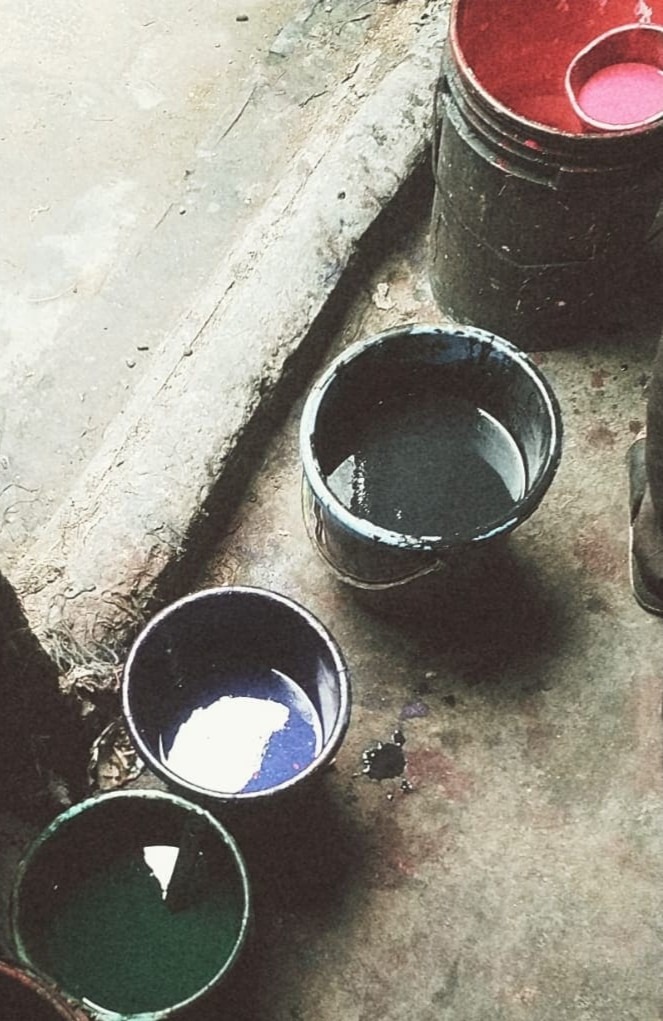
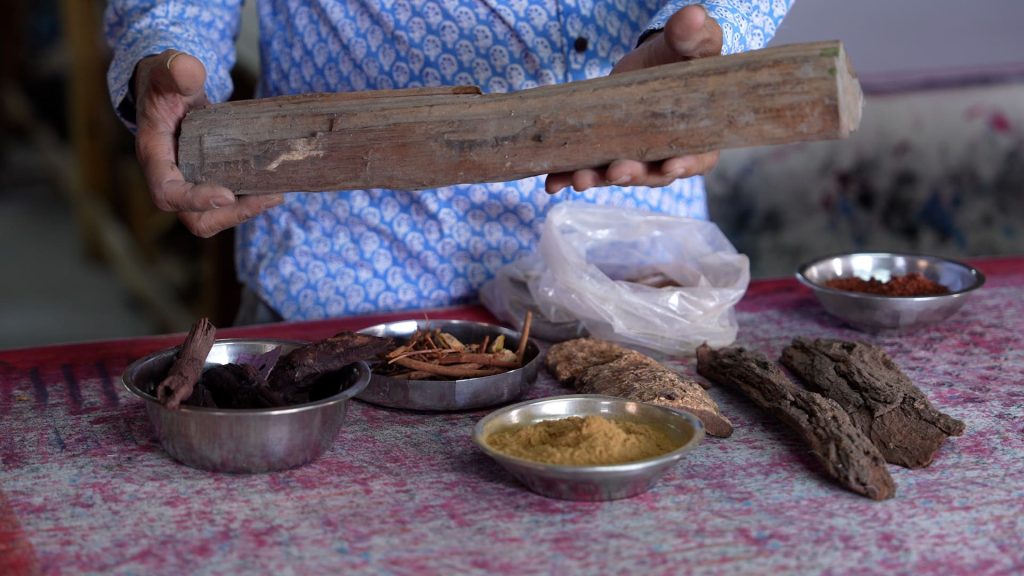
There is also a practical side to this change. Vegetable dyes require considerable washing and rinsing, along with the right conditions to carry out the process. When those conditions become difficult to maintain, artisans have to look for methods that allow them to continue working. The arrival of other colours and printing methods gave them those alternatives.
It also raises an interesting question about what we mean when we call a Sanganeri textile “traditional”. The blocks and motifs may remain rooted in the same visual vocabulary, while the colours and processes used to print them may have changed. The craft can therefore look familiar even when an important part of the original process is no longer widely practised.
For the small number of artisans who continue to work with vegetable dyes, this makes the practice even more significant. Their work preserves a process that has become increasingly uncommon in the very place where it was once part of the printing tradition. His answer gives us a reason to look at Sanganeri not only through what has survived, but also through the techniques that are slowly disappearing from its workshops.
The Importance of the Dhundh River to Sanganer and Its Historical Significance
The conversation started diving deeper into the history of Sanganer. He explained the importance of the Dhundh River and how closely its water was once connected to the colouring process used by artisans. We wanted to understand more about the river, its role in the craft and whether it still has any place in Sanganer’s printing tradition today. We asked him:
Which river is associated with Sanganer, and what role did it play in the traditional printing process? Is the river still used by artisans today?
Raj Kumar Pandey explained that Sanganer is located around eight miles southeast of Jaipur and that the Dhundh River once flowed in close proximity to the town. The water of the river contained certain elements that helped make vanaspati colours more lustrous. This made the river an important part of the natural colouring process and gave the colours produced by artisans a quality that was closely tied to the local environment.
The relationship between the river and the craft, however, did not last. He explained that as the 20th century progressed and the old kingdom system began to decline, cheaper foreign colours started replacing natural colours. The availability of these colours, along with newer methods of printing and colouring, changed the way artisans worked. Sanganeri printing also began losing its popularity, while the market became increasingly crowded with newer printing techniques.
Today, the Dhundh River is heavily polluted and is no longer used for colouring textiles.
Now, this also brought up something that is often missing from conversations about traditional crafts. The history of a craft is not limited to its artisans, blocks, motifs or finished textiles. In many cases, it is also tied to the landscape around it. The water used by artisans, the materials available in a particular region and even the climate can become part of how a craft develops.
In the case of Sanganer, the Dhundh River was not simply a geographical feature near the town. If his account is taken into consideration, its water had a practical role in the making of the colours that gave Sanganeri textiles their character. Once that water could no longer be used, an important connection between the craft and its surroundings was lost.
There is also a larger story of change here. The decline of the Dhundh’s role did not happen in isolation. Natural colours were already being replaced by cheaper alternatives, and new printing methods were entering the market. The pollution of the river added another layer to a craft that was already adapting to changing circumstances.
It makes the Dhundh River an important part of Sanganer’s craft history, even though it no longer plays the role it once did. For a printing tradition that developed around natural colours and processes, the loss of a natural resource that artisans once depended on is a significant part of its story. Today, the river may no longer contribute to the colours on Sanganeri textiles, but its place in the history of how those colours were made remains worth remembering.
Chhipa Community Origin
During the conversation, he also went back in time to explain the origin of the Chhipa community. He touched upon social circumstances, religious figures and the way certain communities came to be associated with particular occupations. It was fascinating to hear how these factors, according to the community’s own oral history, shaped their eventual association with the world of printing and textiles. We asked him:
Where does the Chhipa community trace its origins to, and how did the community become associated with block printing?
According to Raj Kumar Pandey, the Chhipa community traces its origins to the tradition of Shri Vithal Namdev of Pandharpur, whom he credits with challenging caste-based discrimination. He also pointed to Namdev’s devotional tradition, noting that his way of speaking and reciting bhajans is referenced in the Guru Granth Sahib.
He explained that the broader Namdev community is divided into different groups, including the Taak community, traditionally associated with stitching, and the Namdev Chhipa community, whose primary occupation became printing.
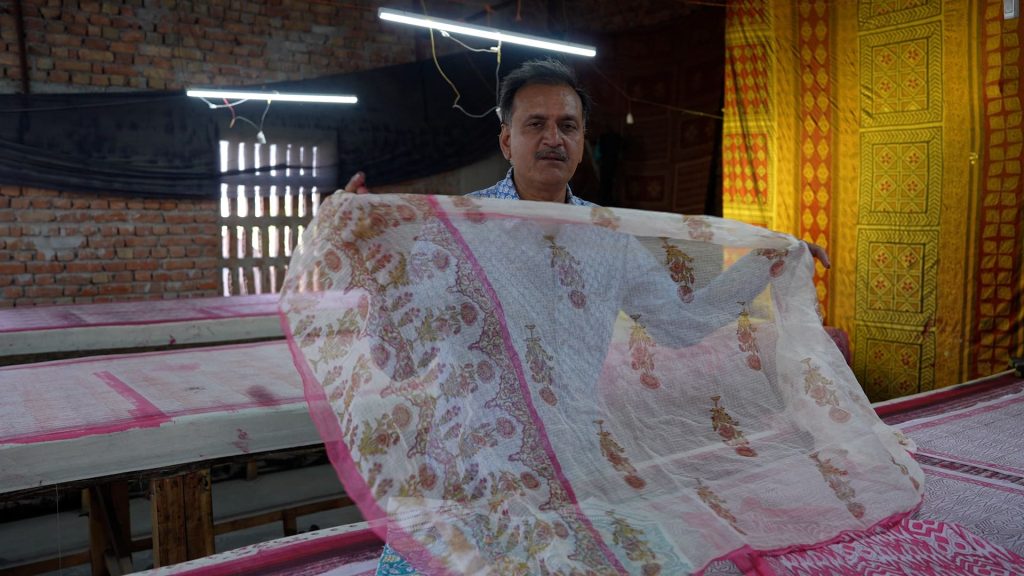
He also shared an important part of the community’s own understanding of its ancestry. According to him, Chhipas continue to consider themselves descendants of the Rajput and Kshatriya communities. He connected this belief to the story of Lord Parshuram and his conflict with the Kshatriyas. In this account, some members of the Kshatriya community took up occupations such as stitching and printing. Those who took up stitching came to be associated with the Taak community, while those who took up printing became known as Chhipas.
Pandey further explained that the word Chhipa has a connection to Kathiawad in Gujarat. His interpretation is that occupational identities played an important role in the naming of communities. Those engaged in printing came to be identified by the work they practised, just as several other traditional communities came to be associated with their respective crafts and occupations.
His answer highlighted how the history of a craft community cannot always be separated from the social history surrounding it. The Chhipa identity, in his account, is not simply about a group of people who happened to take up block printing. Their association with the craft developed through a combination of community traditions, occupational divisions and circumstances that shaped the work they carried forward.
There is also an interesting distinction here between the history of the craft and the history remembered by its practitioners. The origins of the Chhipa community have been explained in different ways, including accounts that connect the community to migrations from Gujarat. Pandey’s explanation gives us another perspective, one rooted in the community’s own oral tradition and understanding of its ancestry.
His account also puts the profession itself at the centre of the story. Printing was not merely an occupation that the Chhipas adopted at some point in history. It became closely tied to the identity of the community. The distinction he makes between the Taak community and the Namdev Chhipa community further shows how stitching and printing developed as separate occupational paths within the broader tradition.
For an art form that is often discussed through its blocks, colours and motifs, this part of the conversation brings attention back to the people who carried it forward. The history of Sanganeri printing is also the history of the communities that made printing their livelihood, passed the knowledge down through generations and continued to identify themselves through the craft.
The Relationship Between Bagru and Sanganeri Printing
As the conversation went on, even more interesting topics were brought up. While discussing the relationship between Bagru and Sanganeri printing, he explained how the two traditions are connected and what, according to him, sets them apart. We asked:
What is the relationship between Bagru and Sanganeri printing, and what makes the two traditions different from each other?
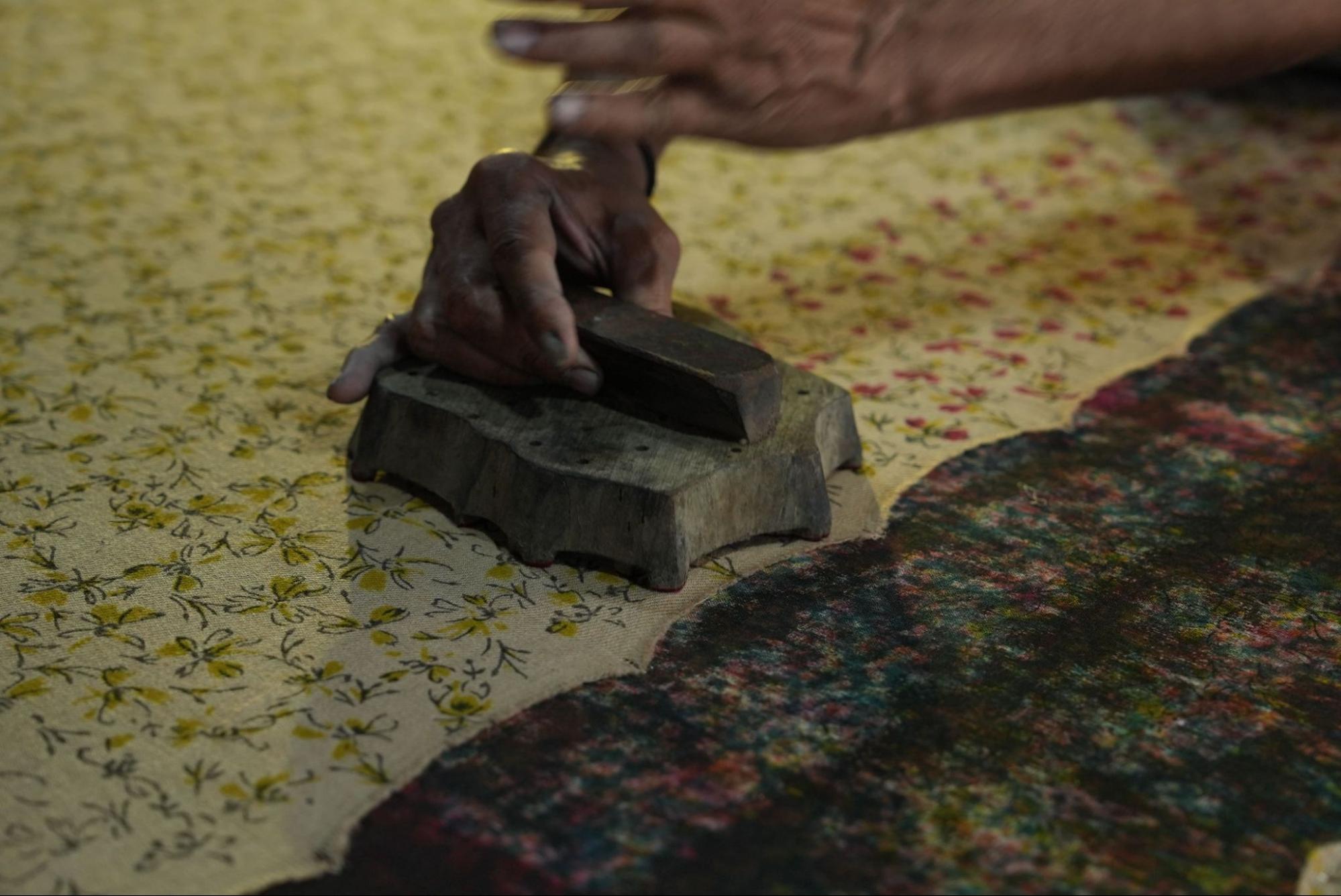
According to Pandey, Bagru printing primarily comes from Sanganeri printing. He explained that the main difference lies in what happens to the fabric after it has been printed. In Bagru printing, the printing itself is the primary process. In traditional Sanganeri printing, the cloth goes through another stage after washing. It is treated with cow dung for three days as part of the bleaching process, which he considers an important part of the Sanganeri method.
This explained why the two printing traditions, despite being associated with the same region and often being discussed together, can have different processes behind them. The distinction is not simply about the patterns or colours seen on the finished fabric. It also lies in what happens to the cloth before and after the blocks make their impression.
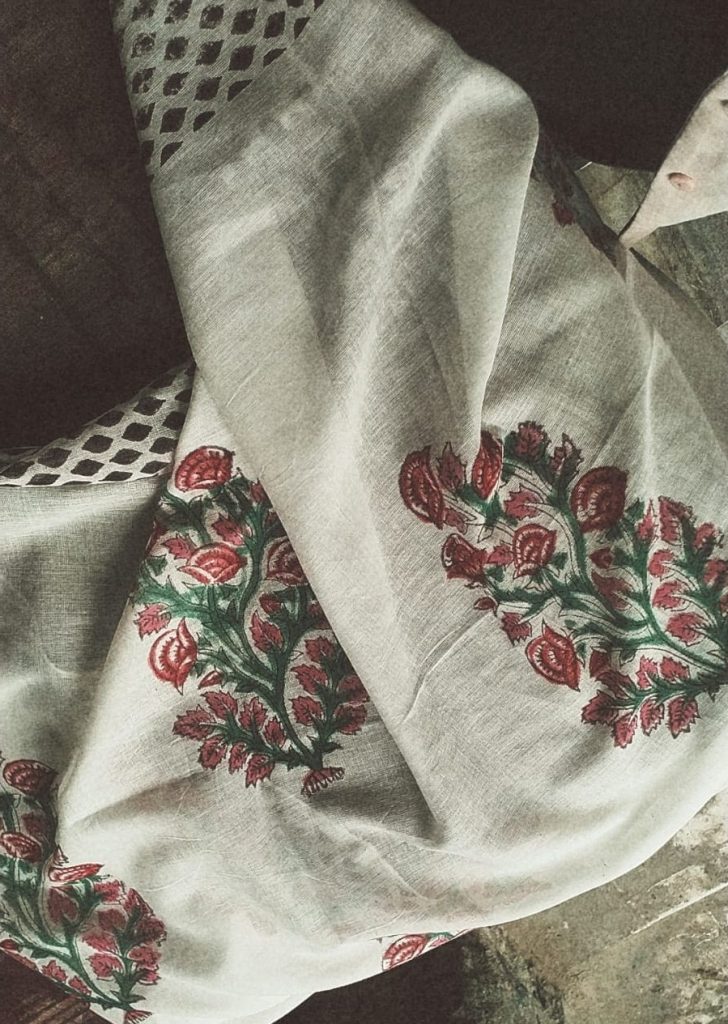
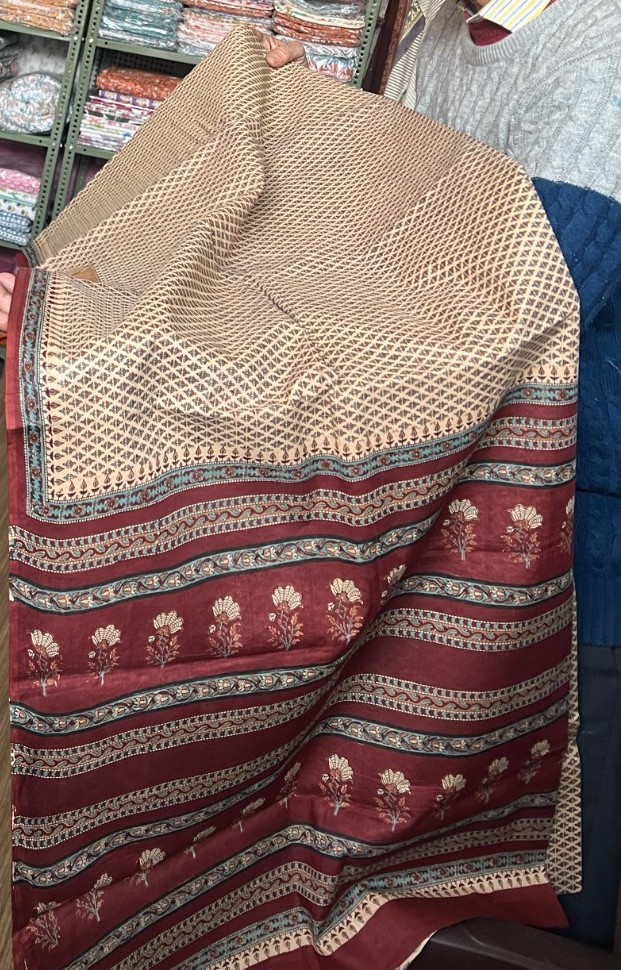
His answer also offered a different way of looking at the relationship between Bagru and Sanganeri printing. They are often presented as two distinct traditions with their own identities, techniques and visual characteristics. His account suggests a much closer relationship between the two, with Sanganeri forming a significant part of the process from which Bagru printing developed.
That makes the comparison between the two crafts more complicated than simply placing them side by side. Their similarities may come from a shared printing tradition, while the differences can be found in the treatment of the fabric and the processes followed by artisans. It is another example of how a craft can develop different identities while remaining connected to a common history.
The History of Indian Colour Printing Tradition
Having such a significant name in the world of traditional printing to speak with, it was impossible not to bring up the history of Indian colour printing. Sanganeri printing is part of a much larger textile tradition, one that has developed over centuries and travelled far beyond the regions where these crafts originated. We wanted to understand how far back this knowledge of colour could be traced and what made Indian textiles so distinctive. Hence, we asked Raj Kumar Pandey:
How old is India’s tradition of colouring and printing textiles, and what do we know about the way colours were used in Indian textiles through history?
He took the conversation much further back than the history of Sanganeri printing itself. According to him, the roots of India’s knowledge of colour can be traced to the Indus Valley civilisation, with red-coloured textile remains being among the early indications of this tradition. He explained that the use of colour in Indian textiles has a long history, with references to colourful clothing appearing across old literature and paintings.
For him, the significance of these colours went beyond simply making a piece of cloth visually appealing. He explained that people in earlier periods had developed a sophisticated understanding of colour and used different shades according to occasions and circumstances. Even the relationship between colour and an individual’s appearance was taken into consideration. Different colours could be chosen to complement a person’s skin tone, showing how closely colour was connected with clothing and personal presentation.
He also referred to accounts associated with the life of Lord Buddha. According to him, old writings describe the people of Vaishali wearing clothes that complemented their skin tones when they went to meet Buddha. He also pointed to descriptions of Buddha’s deceased body being covered with textiles in different colours, including yellow and blue.
His account then moved beyond India. He explained that Indian textiles became highly sought after across Asia and other parts of the world during the early centuries before Christ. The reputation of Indian textiles, according to his account, was closely connected to the country’s knowledge of colour and its ability to produce vibrant textiles.
He also referred to a fourth-century text associated with Pope Gregory, which he said praised the quality of Indian coloured textiles and placed their craftsmanship beyond comparison with the knowledge available in the West at the time.
The historical references he brought into the conversation show just how far back he believes India’s relationship with colour extends. Long before Sanganer became known for its distinctive block prints, Indian textile traditions had already developed an extensive vocabulary of colour and methods of working with it.
This also puts Sanganeri printing into a larger context. The craft did not emerge in isolation. The knowledge of preparing colours, understanding their behaviour on fabric and using them to create visual compositions forms part of a much older Indian textile culture. Generations of artisans built upon this knowledge, developing their own techniques according to the materials, environment and communities around them.
There is something particularly interesting about the way Raj Kumar Pandey describes this history. His focus is not only on the survival of particular techniques but also on the cultural importance of colour itself. Colour appears in his account as something that was understood, selected and used with considerable thought. It was connected to clothing, social occasions, appearance and even religious traditions.
His answer, therefore, takes the discussion of Sanganeri printing beyond the blocks and fabrics of Sanganer. It reminds us that when we look at a brightly coloured Indian textile today, we are looking at one part of a much older relationship between India and the art of colouring fabric.
Of course, several of the historical references in this account come from the oral and traditional knowledge shared by Raj Kumar Pandey and would require further historical verification before being treated as established fact. What they do provide is an insight into how a master artisan understands the lineage of his craft. For him, Sanganeri printing belongs to a much larger Indian tradition in which the knowledge of colour has been refined, passed down and adapted over generations.
The Difference Between Taak and Chhipa and Why It Matters
The conversation around the Chhipa community also brought up an interesting distinction within the wider Namdev community. Pandey explained that while both the Taak and Chhipa communities share a common connection to the Namdev tradition, their traditional occupations took them in different directions. Since both stitching and printing have played an important role in India’s textile traditions, we wanted to understand where these two communities stood in relation to each other. We asked Mr. Pandey:
What is the difference between the Taak and Chhipa communities, and how did their respective occupations become associated with them?
According to Pandey, the Namdev community is broadly divided into different groups, among which the Taak community is associated with stitching, while the Namdev Chhipa community is associated with printing. The two therefore share a connection through their broader community history, but their traditional occupations developed along separate lines.
Pandey’s explanation also connected this occupational division to the community’s own account of its history. He said that members who took up stitching came to be identified with the Taak community, while those who took up printing came to be known as Chhipas. Over time, these occupations became closely tied to the identity of the respective communities.
The distinction is useful because it shows that the people behind India’s textile traditions cannot always be grouped together simply as artisans or textile workers. Different communities developed specialised skills, and those skills often became part of their social identity. Stitching and printing may both belong to the larger world of textiles, but they require very different forms of knowledge and practice.
There are similarities between the two as well. Both are connected to the same broader textile culture and, according to Pandey’s account, share roots within the Namdev community. Both also represent forms of specialised craft knowledge that were traditionally passed down through generations. Their work was not limited to a single finished product. It involved an understanding of materials, techniques and the demands of the textile world around them.
Their difference lies primarily in the craft they chose to carry forward. A Taak artisan’s knowledge centred on stitching and working with fabric, while a Chhipa artisan’s knowledge developed around printing, blocks and colour. As these skills were passed down, the occupation itself became an important part of the community’s identity.
This distinction matters when looking at the history of Sanganeri printing because it brings the discussion back to the people who actually sustained the craft. It is easy to discuss block printing as a technique and focus on the blocks, colours and motifs. However, behind every one of those elements was a community with its own occupational history and inherited knowledge.
Pandey’s explanation also gives some context to the name Chhipa itself. He associates the community’s identity with printing and explains that occupational identities played an important role in how communities were identified. In this understanding, the name is closely connected to the work that the community came to practise.
The relationship between Taak and Chhipa gives us another way to understand the development of traditional Indian textile crafts. The two communities may have followed different professional paths, but both contributed to the larger textile culture in which Sanganeri printing developed. Looking at these distinctions helps us move beyond the finished fabric and understand the communities, occupations and inherited knowledge that made the craft possible in the first place.
The conversation with Raj Kumar Pandey proved to be extremely enriching. What Rajasthan Studio particularly appreciated was his candidness and honesty. He did not shy away from talking about the changes Sanganeri printing has gone through, the techniques that are no longer widely practised, or the realities facing the craft today.
The art is always bigger than the artist, but conversations like this show why the artist’s voice still matters. Pandey’s understanding of Sanganeri printing comes from seven generations of practice and more than three decades of his own experience. His answers brought details that are difficult to find in written accounts, from the drastic decline of vegetable dyes to the role of the Dhundh River and the community’s understanding of its own origins.
What made the conversation particularly valuable was that Pandey did not present Sanganeri printing as something frozen in the past. He spoke about what has changed, what remains and what has been lost along the way. For anyone trying to understand the craft beyond its finished prints, that perspective adds a much-needed layer to the conversation.
Your Chance to Meet Raj Kumar Pandey
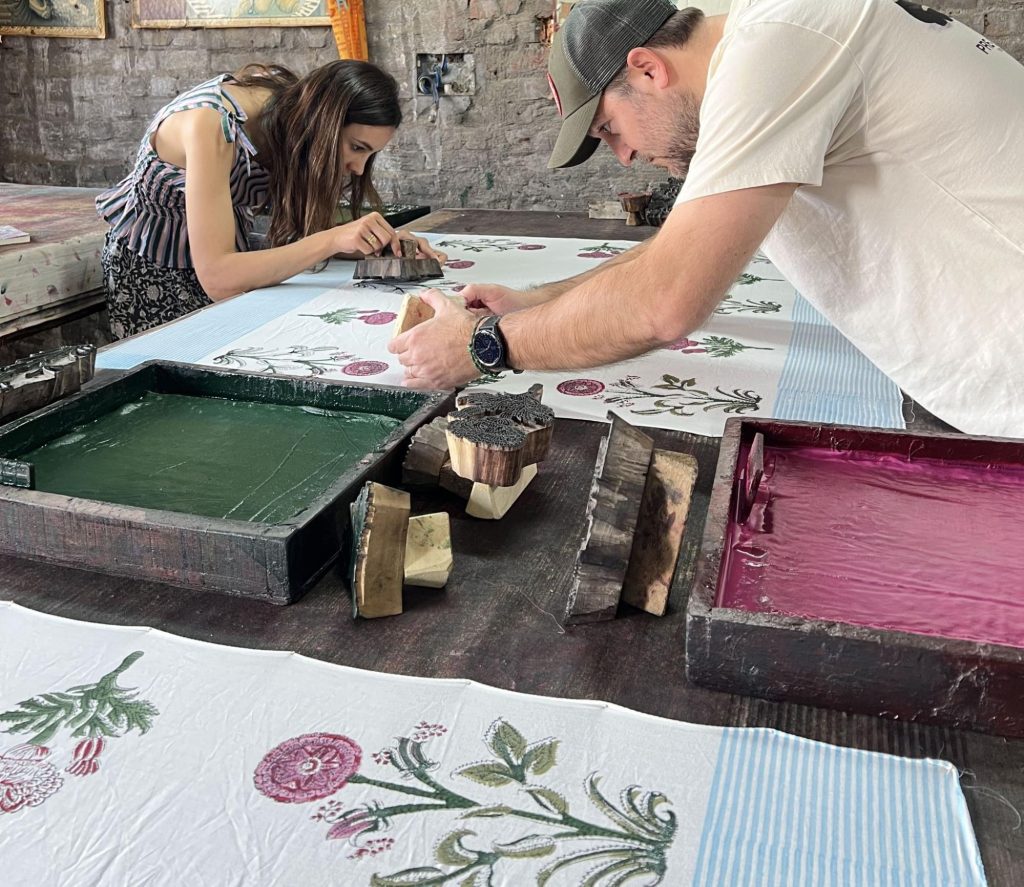
If this conversation has made you curious about the Sanganeri printing, there is no better way to explore it than by experiencing the craft in person. If you are in Jaipur, you can meet Raj Kumar Pandey through our Sanganeri block printing experience. You will get to hear more about the craft directly from the artist and you can also take part in the process yourself. The experience gives you a chance to engage with the craft beyond the finished textile. Meet the artist, hear more stories from the world of block printing and try your hand at the craft with Rajasthan Studio.