Art and craft workshops in Jaipur
Jaipur’s crafts, taught by the people who do them for a living.
Meenakari is enamel on gold and silver, and the colours go on in sequence, hardest firing temperature first, with the piece returning to the kiln between each one. A mistake on the last colour ruins everything under it. It is still done by hand in workshops behind the shopfronts of Johari Bazaar.
Jaipur blue pottery contains no clay at all. The body is quartz powder, powdered glass, fuller’s earth, borax and gum, which is why it comes out that particular blue-white and why it cracks if you hurry the drying.
Tarkashi is fine metal wire set into wood, groove by groove, and the number of families in the city still doing it properly is small enough to count on your hands.
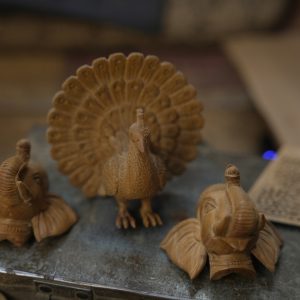
Then there is block printing, miniature painting, lac work, gemstone carving, paper mache, wooden block making, fresco, clay sculpting and sandalwood carving. Each one has a household behind it rather than a school, and an artist who has spent a working life at it.
None of these artists need rescuing. They have work coming in. What makes the good ones worth booking an experience in Jaipur with is that they will stop and teach anyway, at a pace where you can actually see what their hands are doing.
Some of them are known well past Jaipur. Miniature painting can be learned here with Padma Shri S. Shakir Ali, who still takes a few travellers at a time through the brushwork and the pigments over a single unhurried session. Kathputli puppets sit at the other end of the scale of formality: carved from mango wood, dressed in cloth, and built without legs because the skirt does the work. They are taught here by a family that has kept the craft going through several generations of performing it.
City and food walks in Jaipur
The old city’s markets, shown by someone who grew up in them.
Johari Bazaar is jewellers. Bapu Bazaar is textiles and juttis. Both are loud in a way that takes about twenty minutes to stop being stressful, and a guide is the difference between twenty minutes and the whole morning. Shops stack three storeys. Handcarts and scooters share the same six feet of lane. Somebody is always shouting a price at somebody else.
On the Jaipur food walk you eat ghewar and its paneer version, pyaaz kachori, kesar pista lassi, aloo tikki and jalebi, and finish with chai boiled over coal and served in a clay kullad. Ghewar is really a monsoon sweet, so it is at its best between July and September, and anyone honest will tell you that. Every tasting is vegetarian. The people handing you the plate are the halwais and chaiwallahs themselves, not a counter hired for the morning.
The city walk covers the same old city at a different angle, moving between the bazaars, the temples and the courtyards that a rickshaw drives past at speed.
Planned geometry, unplanned everything else
Jodhpur grew around a fort. Udaipur grew around a lake. Jaipur was drawn on paper before it was built, in 1727, by Sawai Jai Singh II and his architect Vidyadhar Bhattacharya, laid out as nine rectangular blocks on principles taken from the Shilpa Shastra. Two of the nine went to the palace complex. The rest were divided up by trade, which is why the crafts still cluster the way they do three centuries later.
Jai Singh also brought in the people. Enamellers, stone cutters, weavers and painters were invited from across northern India to settle in the new city and given land to work from. Jaipur’s craft density today is a direct result of a town planning decision made in the 1720s.
The pink arrived much later. In 1876, Sawai Ram Singh II had the old city painted to receive the Prince of Wales, and a municipal rule later fixed the colour for buildings inside the walls. So the pink is a bylaw. It is so uniform across the walled city that after a day you stop noticing it, which is roughly the opposite of what the postcards promise.
Hawa Mahal went up in 1799 with 953 windows, built so the women of the court could watch the processions on Tripolia Bazaar without being seen from the street. City Palace still sits at the centre and is still lived in. The part of the city that has stayed most alive, though, is the lanes behind both of them.
Jaipur eats without much ceremony. Dal baati churma, ker sangri, a plate of pyaaz kachori eaten standing up at a stall on the way somewhere else. Around Johari Bazaar and Tripolia Bazaar, none of it has been adjusted for visitors.
Why Explore Jaipur with Rajasthan Studio
Finding an artisan in Jaipur is easy. Finding one who wants to teach, rather than move you politely toward the shop attached to the workshop, is harder, and that filtering is most of the work. We know which block printer will hand you the block instead of demonstrating with it, which Meenakari artist is happy to be interrupted with questions, and which miniature painter has the patience for a first attempt that goes wrong.
We have been running these sessions in Jaipur since 2019, and in a city full of artists, that filtering and curation matters. We’ve met artists and understood how they are as hosts, not just how they are as artists. So when you are coming for an experience in Jaipur, you are exploring the craft at your own pace with someone who actually wants you there.
Planning your time in Jaipur
Three days covers the main sights and one workshop in Jaipur without hurrying. Four lets you add a second craft and a proper bazaar walk. A week is when the city starts to make sense, and almost nobody gives it a week. If you are passing through for a single day, pick one thing and do it properly. A rushed morning at Amber Fort followed by a rushed afternoon workshop is a worse day than either one on its own.
October to March is the season, cool in the morning and warm by two in the afternoon. April to June runs 40–45°C and the bazaars empty out by mid-morning, so go early or not at all. July to September brings the monsoon, the fewest visitors of the year, and ghewar.
Frequently Asked Questions for Things to do in Jaipur